Why Creator Monetization Is Still Broken (and Why 'Just Use Blockchain' Hasn't Fixed It)
In the last post, I outlined the core problem: creators are forced to choose among platforms that each support only one monetization model, and the fees they pay for that convenience are steep. In this post, I want to dig into why blockchain-based fixes proposed over the last several years still haven’t closed the gap — because understanding exactly where they fall short shaped the design of CCRMS.
Let’s start with the consumer side, because fragmentation cuts both ways. A film purchased on iTunes can’t be streamed on Amazon Prime. An Audible audiobook can’t be moved to Google Play. A subscription started on one platform can’t be transferred to another. Consumers don’t own what they buy in any meaningful sense; they hold a platform-bound license that the platform can revoke, modify, or ignore at its discretion. The fragmentation that constrains creators also restricts the people who support them.
Blockchain-based approaches have been chipping away at this for a few years now, and the academic literature on it is more mature than you might expect. Researchers have combined digital watermarking with blockchain to create tamper-evident protection layers. Others have built hybrid encryption architectures or extended the model with perceptual hashing so content can be selectively modified without invalidating ownership proofs. In the music industry specifically, researchers have derived a set of design principles for blockchain-based digital rights management through expert interviews and prototype testing: transparency of rights ownership, automated royalty distribution, and programmable licensing. Those are good principles. The problem is that nearly all of this work optimizes for protection — stopping piracy and proving provenance — rather than for monetization, which actually helps a creator get paid the way they want to get paid.
NFTs: The Most Visible Attempt
NFTs deserve a specific callout here because they’re the most visible blockchain approach to content rights, and the data on how well they work is not flattering. One of the more rigorous recent studies found that 80 percent of mainstream NFTs fail to transfer copyright to purchasers. Only 12 to 30 percent of marketplace listings include licensing information, and 50 to 60 percent of secondary sales bypass creator royalties entirely. An independent meta-analysis of 125 NFT studies confirmed these findings and concluded that legal clarity around NFT ownership transfers remains the field’s biggest unsolved problem. The infrastructure is theoretically capable of effective rights management, but in practice, almost nobody uses it that way.
The Micropayment Problem
Pay-per-view has its own, more technical problem: the micropayment problem. On most blockchains, gas fees have historically exceeded the cost of the content itself, making per-view payment models a non-starter. There’s been real progress here. Some researchers have proposed multi-agent, privacy-preserving approaches that batch transactions to reduce per-transaction overhead. Coinbase’s x402 protocol, launched in 2025, embeds payment logic directly in HTTP responses and enables stablecoin settlement in about two seconds — a genuinely useful industry development. But these are point solutions to one piece of the puzzle, not a foundation for a system that also needs to handle subscriptions and permanent ownership.
The Story Protocol Comparison
Then there’s the most direct comparator to what I built: Story Protocol, launched in February 2025 as the first dedicated intellectual-property Layer 1 blockchain, built on the Cosmos SDK with EVM compatibility and backed by USD 140 million in funding. Story’s Programmable IP License can be configured to approximate subscription, pay-per-view, and ownership models. But it requires separate license-token types and configurations for each, and it doesn’t natively support time-bounded subscription renewal as a first-class concept. This validates that the market believes this problem is worth solving at scale. It also highlights the architectural contrast I was interested in exploring: a single-chain Layer 1 versus a cross-chain parachain that inherits shared security from a relay chain.
Where the Gap Is
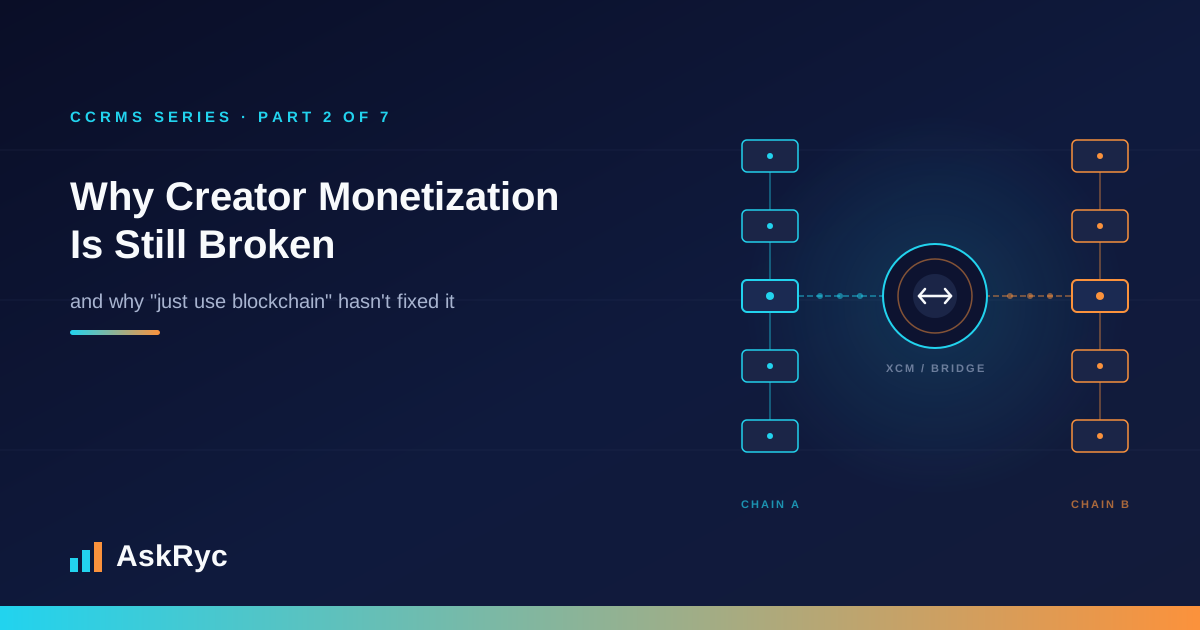
Cross-chain interoperability research adds another piece to this picture. There’s now a mature body of academic surveys that classify interoperability approaches into categories such as sidechains, notary schemes, hashed time-lock contracts, relays, and blockchain-agnostic protocols. Yet researchers focusing specifically on cross-chain copyright management kept arriving at the same conclusion: many have proposed theoretical frameworks, but none had built a working end-to-end prototype that delivered all three monetization models across chains.
So here’s the gap, as I came to see it, distilled to its essence. The technical building blocks — cross-chain messaging, programmable smart contracts, on-chain royalty distribution, and NFT-based rights tokenization — already exist as standalone capabilities. What didn’t exist was a system that integrated them into something a creator could actually use: a single rights primitive that natively supports all three monetization models, is portable across blockchain networks, and doesn’t require novel cryptography or a completely new consensus mechanism.
That’s the design target CCRMS was built to meet. In the next post, I’ll dive into the mechanism: how you encode three semantically distinct access modes — subscription is time-bounded, pay-per-view is usage-counted, and ownership is indefinite — into a single on-chain token without one mode’s state bleeding into another’s.
This is Part 1 of the CCRMS series. The full series walks through the architecture, engineering decisions, and honest results of building a cross-chain content rights system on Polkadot.