What Technical Due Diligence Really Means for Web3 Infrastructure
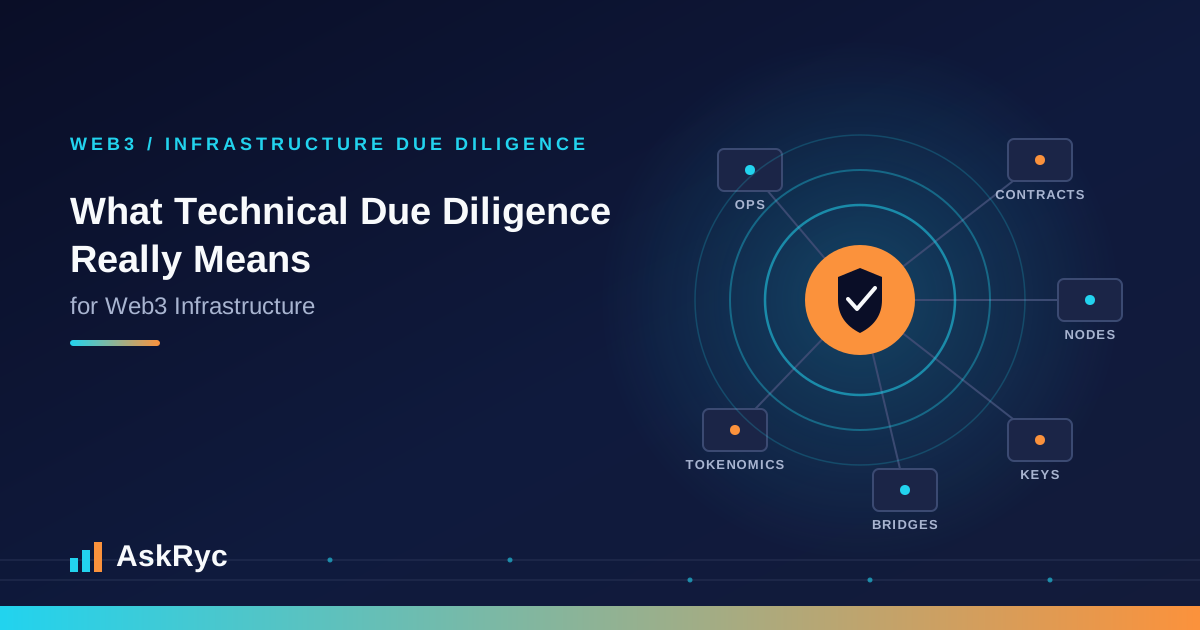
When investors, exchanges, or enterprise partners say they’ve done “technical due diligence” on a Web3 project, they often mean they skimmed a smart contract audit report and saw an active GitHub repo. That’s not due diligence. It’s a smoke test. Real Technical Due Diligence on Web3 infrastructure must evaluate a stack spanning cryptography, distributed systems, economic incentive design, and operational security — because a failure in any one layer can drain a treasury regardless of how sound the others are. Having sat on both sides of these reviews, here’s what rigorous Technical Due Diligence actually covers.
1. Smart Contract and Protocol-Layer Risk
An audit report is a starting point, not a conclusion. The questions that matter: Which firm audited it, and does their track record match this codebase’s complexity? Were findings actually remediated, or merely acknowledged? Was the audited commit hash the one that shipped to mainnet? (A shockingly common gap.) Static analysis (Slither, Semgrep) and property-based fuzzing (Echidna, Foundry’s invariant testing) should be table stakes for anything moving meaningful value; formal verification (Certora, or TLA+ for consensus-critical logic) matters for anything handling systemic risk, such as lending protocols or stablecoins.
Equally important is the upgrade pattern. A Transparent or UUPS proxy behind a single externally owned account (EOA) admin key is a single point of failure dressed up as “upgradeability.” I want to see a timelock (48+ hours, ideally longer) and a multisig or DAO-gated upgrade path before I trust it with capital.
2. Node Infrastructure and Client Diversity
Decentralization claims need to be verified, not taken on faith. What’s the actual validator or node distribution, both geographically and across hosting providers? A network that claims to be “decentralized” yet has 40% of its stake concentrated in three cloud regions faces real risks of outages and censorship. Client diversity matters just as much: Ethereum’s near-miss with a supermajority on a single execution client (Geth) is the canonical example of how monoculture client risk can threaten consensus safety itself.
For app-layer teams, I also check RPC dependencies: if the entire product falls over when Infura or Alchemy has a bad day, that’s an availability risk that belongs in the Technical Due Diligence report, not a footnote.
3. Key Management and Custody
This is where most catastrophic losses originate: not clever exploits, but sloppy key handling. Who holds admin, deployer, and treasury keys? Is signing performed using hardware security modules or Multi-Party Computation with threshold signatures (for example, Fireblocks or a comparable solution), or is there a hot wallet with the private key stored on someone’s laptop?
For any multi-signature setups, I require details on the signer count, the approval threshold, the geographic and organizational distribution of signers, and evidence of a tested incident response runbook. I do not want merely an untested Safe address configured as 3-of-5.
4. Oracle, Bridge, and External Dependency Risk
Most major protocol losses in the last several years stem from oracle manipulation or bridge compromise rather than core contract bugs. The Technical Due Diligence report has to map every external dependency: price feed source and manipulation resistance, update frequency versus market volatility, and, for any cross-chain component, the bridge’s trust model. A bridge secured by a 5-of-8 multisig of unnamed signers is architecturally different from one secured by light-client verification or a decentralized validator set — and that distinction should materially change your risk pricing.
5. Tokenomics as Attack Surface
Economic design is security design. Governance token concentration, flash-loan-enabled voting power, emission schedules that create sell-pressure cliffs, and liquidity depth relative to the token float are all technical risks — not just financial ones. Many of the largest DeFi exploits were economically rational attacks on correctly functioning code, not bugs at all.
6. Operational Maturity
Finally, I look at the process: is there an active bug bounty with a realistic payout scale, a documented incident response plan, monitoring for anomalous on-chain activity, and a documented history of how the team responded to past incidents (if any)? A team that handled a minor exploit transparently and shipped a postmortem is often a better bet than one with a spotless record and no evidence that it’s ever been tested.
The Bottom Line
Technical due diligence for Web3 infrastructure isn’t a checklist item that a PDF audit report can satisfy. It’s a systems-level assessment of code, infrastructure, custody, and incentive design — because in this industry, failure modes are adversarial, irreversible, and public. Treat Technical Due Diligence as continuous, not a one-time gate before a term sheet.
If you’re evaluating a Web3 infrastructure target and want a domain-specialist assessment, the Technical Due Diligence engagement is designed for exactly this.